LightBlog

jeudi 27 février 2020

Google’s Pixel Feature Drop for March may include dark mode scheduling, Quick Access Wallet, and more

Back in December last year, Google introduced a new approach to bring feature updates for its Pixel series. Instead of rolling out new features whenever they were ready, the company adopted a more systematic approach and announced that it will be rolling out a new “feature drop” every three months alongside the Android security patches. The first feature drop was released along with the December security patches and it introduced a couple of new features, including post-snap Portrait Mode, auto Call Screening, and more. As per the release schedule, Google is expected to roll out the second Pixel feature drop next month. While the company hasn’t released any information about what features will be included in the next drop, a teardown of the latest update for the Pixel Tips app reveals all that’s coming in the next drop.

The teardown in question was conducted by our friends over at 9to5Google and here’s what they discovered:

Dark Mode scheduling

Dark Mode scheduling first made an appearance in an early beta release of Android 10, alongside the new system-wide dark mode. The feature allowed users to schedule dark mode to activate automatically either at sunset or a custom time. However, the feature was deprecated before the stable release as the company believed that it might negatively affect the user experience by suddenly restarting applications while they’re in use. Then, back in December last year, a comment on the Google Issue Tracker revealed that the company was still working on the feature, suggesting that the feature could make a comeback in Android 11.

<string name=”tips_darktheme2_feature_description”>Dark theme turns on automatically at sunset</string>
<string name=”tips_darktheme2_feature_name”>Schedule Dark theme</string>
<string name=”tips_darktheme2_link”>Dark theme settings</string>
<string name=”tips_darktheme2_media_description”>Video about Dark theme. To add Dark theme to Quick Settings, swipe down twice from the top of your screen and tap Edit.</string>
<string name=”tips_darktheme2_summary”>”Dark theme uses a black background to keep your battery alive longer. It also changes the appearance of your Google apps, like Gmail and Photos.\n\nAdd Dark theme to your Quick Settings to turn it on or off anytime. Touch and hold to set up a schedule.”</string>
<string name=”tips_darktheme2_title”>Take it easy on your eyes and your battery with Dark theme</string>

The feature was spotted, once again, in the recently released Android 11 Developer Preview, which led us to believe that that it was an Android 11 exclusive feature. However, according to new strings of code spotted in the aforementioned teardown, the feature might be released in the upcoming Pixel feature drop for Pixel devices running Android 10. The code mentions that the feature will be available within the dark theme settings and users will also be able to set a schedule by long pressing on the dark theme Quick Settings tile.

Cards & Passes

Another feature that was spotted in early beta releases of Android 10 is also making its way to Pixel devices with the next feature drop. The feature, called Cards & Passes, will allow users to quickly access cards that they’ve saved in Google Play in the power menu. Much like Dark mode scheduling, this feature was also spotted in the first Android 11 Developer Preview, which led us to believe that it will be launched with the next iteration of Android.

<string name=”tips_powerkey_features_link”>Cards &amp; passes settings</string>
<string name=”tips_powerkey_features_feature_name”>Quick access to wallet</string>
<string name=”tips_powerkey_features_summary”>”Press &amp; hold the Power button to access payment methods, passes, and emergency info.
– Payment methods in Google Pay: If your phone is locked, you’ll need to unlock it to complete payment.
– Boarding passes and tickets: Available from the lock screen before a flight or event.
– Emergency info: To help in an emergency, people with access to your phone can view your medical info and dial your emergency contacts without unlocking your phone.”</string>

However, strings of code discovered by 9to5Google suggest that it might be released in the March feature drop. The code clearly highlights how the feature will work when released and also offers a couple of different use cases for the feature. For instance, the Cards & Passes feature will allow users to quickly access their saved cards, flight or event tickets, and emergency information from the power menu on the lock screen itself. It also clarifies that even though users will be able to access the information on the lock screen, they will have to unlock their phones in order to complete payment.

Play/Pause Motion Sense gesture

The first Android 11 Developer Preview also highlighted a new Motion Sense gesture for the Pixel 4 series that would allow users to play/pause music without even touching their device. The Pixel Tips teardown highlighted code related to this feature as well, which suggests that it might be released for Pixel 4 devices on Android 10.

<string name=”tips_oslo_music_feature_description”>Use Quick Gestures to pause or skip songs</string>
<string name=”tips_oslo_music_summary”>”Pause or resume music by tapping the air above the phone.
Skip songs by swiping left or right above the phone.”</string>

As per the code, the feature will allow users to simply tap the air above the phone in order to pause or resume music playback. It also highlights the skip track gesture that is already available on Pixel 4 devices.

Car crash detection

Lastly, the teardown also reveals that the Personal Safety app from Android 11 might also make its way to older Pixel phones in the next Pixel drop. For the unaware, the app comes preinstalled on Android 11 Developer Preview 1 and includes a car crash detection feature that was previously only available for the Pixel 4 series.

<string name=”tips_carcrash_title”>Get help calling emergency services after a car crash</string>
<string name=”tips_carcrash_feature_description”>With car crash detection, your phone can call emergency services</string>

While we managed to sideload the app on older Pixel devices and enable the car crash detection feature, it’s great to see Google officially bringing it to more Pixel devices. As per the code, the app will automatically call emergency services when it detects a car crash, which can really come in handy in a pinch.

The new set of features for Pixel devices sure seems interesting, but it’s worth noting that these features were discovered in a teardown and Google might skip some of these features in the next Pixel drop. It’s also quite possible that Google might make some significant changes to these features before they’re released.


Via: 9to5Google

The post Google’s Pixel Feature Drop for March may include dark mode scheduling, Quick Access Wallet, and more appeared first on xda-developers.


from xda-developers https://ift.tt/3a948X1
via IFTTT

[Update: May Be Coming Back] The Google Play Store will no longer show notifications for updated apps

Update 1 (02/28/2020 @ 01:54 AM ET): We’ve found strings in a new version of the Google Play Store that indicates that update notifications may be coming back. Scroll to the bottom for more information. The article as published on January 16, 2020, is preserved below.

Late last month we came across an issue with the Google Play Store which prevented some newly published apps from showing up in search. The bug only brought up related search results when searching for new apps, even though they were definitely live on the platform. Google addressed this issue shortly thereafter and users were once again able to look up new apps in the store. At the time, some users also reported another bug on the Play Store which stopped showing app update notifications in the notification shade. The bug was noticed shortly after Play Store version 17.4 rolled out to users and since then, more and more users have come up to share the issues on Reddit and Google’s Support forums.

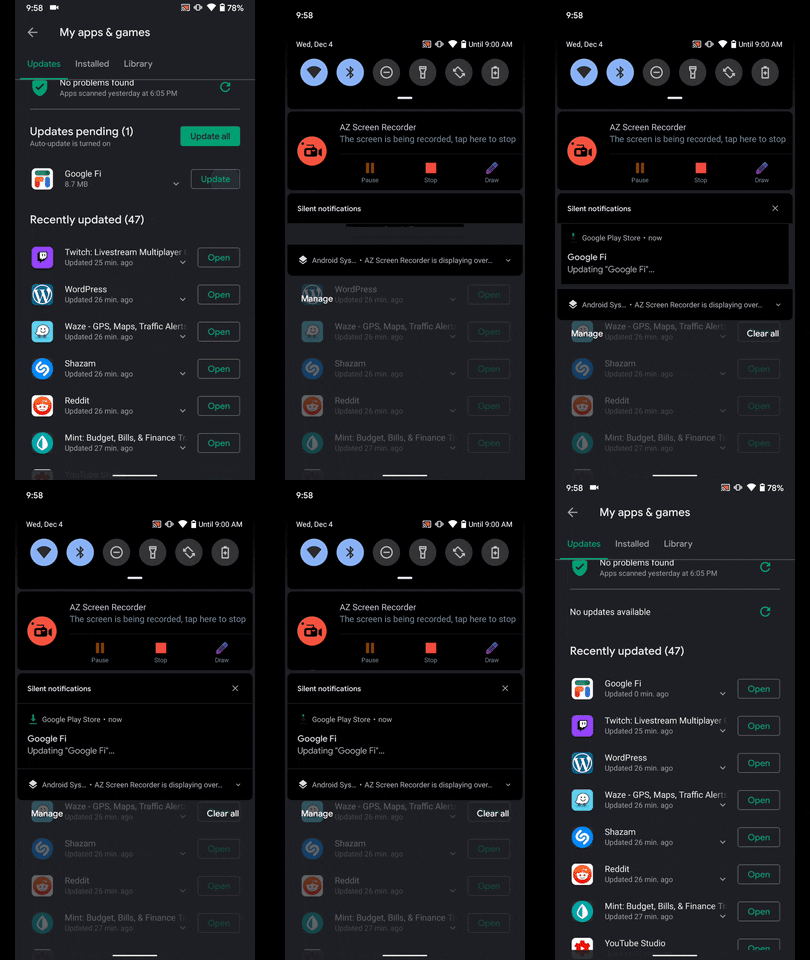
Now, as per a recent report from Android Police, it seems like the missing notifications in the Google Play store is intended behavior. A Google spokesperson reached out to the publication to provide further clarification on the issue and revealed that the missing update notifications were a feature and not a bug. Even though the issue was fixed briefly early in December last year, it remerged earlier this month. As of now, there’s no further information from the company regarding its decision to remove Play Store notifications. Users who wish to check the app update status will now have to navigate to the My apps & games section in the Play Store and manually check for updates. Do note that Google won’t push notifications after app updates are successful.

Via: Android Police


Update: Play Store’s App Update notifications may be coming back

The Google Play Store no longer shows any notifications for when your apps are updated. This change hasn’t exactly been well-received since a lot of people do want to be notified on which apps have recently received an update on their phone. It could be this reason why Google may be planning to bring back the notification.

An APK teardown can often predict features that may arrive in a future update of an application, but it is possible that any of the features we mention here may not make it in a future release. This is because these features are currently unimplemented in the live build and may be pulled at any time by the developers in a future build.

As spotted in Google Play Store v19.0.12, the strings relating to app update notifications have been added back in, indicating that the feature might be brought back.

<string name="updates_completed_notification_channel">Updates completed</string>
<string name="updates_completed_notification_channel_description">Notify when an app is finished updating</string>

This is no guarantee that the feature is destined for a return merely because we spotted these strings in the newer version of the app. However, the existence of these strings is a pre-requisite in case the feature is to be re-added back in. We hope Google has had a change of heart.


Thanks to PNF Software for providing us a license to use JEB Decompiler, a professional-grade reverse engineering tool for Android applications.

The post [Update: May Be Coming Back] The Google Play Store will no longer show notifications for updated apps appeared first on xda-developers.


from xda-developers https://ift.tt/3aaQ7ZP
via IFTTT

Realme 5 Pro and Realme X start getting Android 10 with Realme UI

Realme, a BBK Electronics-owned brand, separated from OPPO in July 2018 as it started operating as an independent brand. However, the company still used OPPO’s ColorOS custom user interface based on Android for all of its phones. In 2019, it first stated that it would develop a new “RealmeOS,” but the plans for the same were shelved in November 2019. Realme shifted gears to developing a lightly customized variant of OPPO’s Android 10-based ColorOS 7, which it called Realme UI. In January, it rolled out the stable Android 10 update with Realme UI to the Realme 3 Pro and the Realme XT. It also opened beta programs for rolling out the update to the Realme X2 and the Realme X2 Pro, while clarifying that the Realme 1, Realme C1, and Realme 2 would not get the update. Now, it has rolled out the stable Android 10-based Realme UI update to the Realme 5 Pro (review) and the Realme X (review).

The Realme 5 Pro and the Realme X are the third and fourth phones by the brand to get the Android 10-based Realme UI update. Realme UI itself is quite similar to OPPO’s ColorOS 7 (review) in terms of design and functionality. The only difference that Realme made to the user interface was to use rounded icons in the home screen launcher instead of the square icons that OPPO uses in ColorOS 7. The underlying functionality of both user interfaces is the same. ColorOS 7 itself brought the user interface closer to stock Android.

Realme notes that the official roll-out for both the Realme 5 Pro and the Realme X will have a staged roll-out, as expected. The update will be randomly pushed out to a limited number of users today, and will have a broader roll-out in a few days after the company makes sure there are no critical bugs. If everything is fine, the roll-out will be completed in the coming days. The manual download links haven’t been updated on Realme’s website yet.

The Realme UI update brings Android 10 to both the Realme 5 Pro and the Realme X. The new user interface is called “Real Design” by Realme. It comes with an optimized Smart Sidebar feature, two new features for Assistive Ball users (pie gestures), bubbles, optimized three-finger screenshot, Focus Mode, new wallpapers and live wallpapers, and more. Realme Share now supports sharing files with OPPO, Vivo, and Xiaomi users. The complete change-log for both phones is noted below:

  • Visuals
    • Updated UI to realme UI
    • Brand new Real Design makes visuals more attractive and operation more efficient.
  • Smart Sidebar
    • Optimized user interface and improved one-handed operation.
    • Optimized Smart Sidebar: Replaced File Console with File Manager; removed OSIE Visual Effect and No Notification Alerts.
    • Drag an app out of Smart Sidebar to open it in Split-screen Mode.
    • Added two new features: “Assistive Ball Opacity” and “Hide Assistive Ball on Fullscreen App”.
    • Optimized the Floating Window feature for more apps.
    • Added Bubbles: A bubble is displayed when you open an app in a floating window from the Smart Sidebar. Tap the bubble to collapse or open the app.
  • Screenshot
    • Optimized 3-Finger Screenshot Gesture: Use 3 fingers to touch and hold the screen, and swipe to take a screenshot of the selected part of the screen (partial screen capture). Use 3 fingers to touch and hold the screen, and swipe your fingers outwards to capture a long screenshot.
    • Added screenshot settings: You can adjust the position of the screenshot preview floating window and set the screenshot sound.
    • Optimized screenshot preview floating window: After taking a screenshot, drag it up and release it to share it, or drag it down and release it to take a long screenshot.
  • Navigation Gestures 3.0
    • Optimized: New Android 10 navigation gestures
    • Optimized gestures: All gestures are supported in landscape mode.
  • System
    • Added Focus Mode: Minimizes outside distractions when you are learning or working.
    • Added whole new charging animation.
    • Optimized the Quick Settings user interface for easier one-handed operation.
    • Added pause feature for screen recording.
    • Added a floating window and settings for screen recording.
    • New sounds added for file deletion, calculator key touches, and compass pointer.
    • Optimized system built-in ringtones.
    • Added TalkBack floating prompts for Accessibility.
    • New management feature for recent tasks: You can view the memory of recent tasks and locked apps.
  • Games
    • Optimized visual interaction for Game Space.
    • Optimized loading animation for Game Space.
  • Homescreen
    • Added new live wallpapers.
    • Added artistic wallpapers.
    • Added option to open Global Search or the notification panel when swiping down on homescreen.
    • Added option to customize the size, shape, and style of app icons on homescreen.
    • Optimized the graphic design of password unlock to facilitate one-handed operation.
    • Support for animated wallpapers on the lockscreen.
    • Added a Simple Mode for homescreen, featuring larger fonts, icons, and a clearer layout.
  • Security
    • Random MAC address Generator: When your phone is connected to Wi-Fi, network system generates a random MAC address to avoid targeted ads and protect your privacy.
  • Tools
    • In Quick Settings or Smart Sidebar, you can open Calculator in a floating window.
    • Added the trim feature in Recordings.
    • Added the Weather (dynamic) ringtone, which automatically adapts to the current weather.
    • Added weather-adaptive animations in Weather.
    • Added audio source selection for screen recording
  • Camera
    • Optimized the Camera UI for better user experience.
    • Optimized the Timer UI and sound.
  • Photos
    • Optimized the Album UI for a clearer structure and photo thumbnails.
    • Added Album Recommendations that recognize more than 80 different scenes.
  • Communication
    • realme Share now supports sharing files with OPPO, Vivo and Xiaomi devices.
    • Optimized the Contacts UI for a more efficient experience.
  • Settings
    • Search Settings now supports fuzzy match and contains a search history.
  • Music
    • Added Dual Mode Music Share in realme Lab

Source: Realme (1, 2)

The post Realme 5 Pro and Realme X start getting Android 10 with Realme UI appeared first on xda-developers.


from xda-developers https://ift.tt/2I36bzQ
via IFTTT

Google Duo prepares to add captions to video and audio messages

Google Duo is one of Google’s most successful communication services, which is saying a lot considering how many previous messaging services they’ve canned. Duo is a very simple-to-use video-calling application available for Android, iOS, and the web, and since its release in 2016, it has become the default video calling app bundled with Google Mobile Services. Google recently added 1080p video calling support over 5G on the Samsung Galaxy S20 family of devices, as well as other features such as sending notes and doodles to your friends and family. One of the best features is the ability to send a short (up to 30 seconds) video or audio message to your contacts if they missed your call. Now, evidence has emerged suggesting that Google Duo will soon support adding captions to your messages.

Jane Manchun Wong, notable for her work in reverse-engineering many popular apps, shared a screenshot of a new Duo setting hinting at this capability. Her screenshot shows two new options in Google Duo’s settings, which most importantly suggest that captioning video and audio messages will soon be possible. The video message feature was added to Duo almost two years ago followed later by audio-only messages. Below the toggle, the description states that the audio content will be sent to Google, but not stored by them, for transcribing the message. It doesn’t seem that this feature will support captioning the audio during a live call, though. Another toggle suggests that you’ll be able locally store videos, voice messages, photos, and notes that are sent to you in Duo. Both new toggles will be available under the new ‘Message settings’ subsection.

If you the own Google Pixel 4, Pixel 4 XL, Pixel 3, Pixel 3 XL, Pixel 3a or Pixel 3a XL, you can already use the built-in Live Caption feature to add captions to most audio being played on your device. That feature works entirely on-device and across apps. Nevertheless, this captioning feature in Duo is definitely welcome, especially for those users who don’t have a recent Pixel device. The new feature hasn’t rolled out yet, and it’s unknown when it will be available. We’ll definitely make note of when the feature is available.

Google Duo - High Quality Video Calls (Free, Google Play) →

The post Google Duo prepares to add captions to video and audio messages appeared first on xda-developers.


from xda-developers https://ift.tt/3c89KT4
via IFTTT

GameBench offers your first look at the Nubia Red Magic 5G and 144Hz gaming

Several companies have gone ahead with their announcements that were supposed to take place at Mobile World Congress this week. Nubia isn’t one of them, as they originally planned to announce the Red Magic 5G this week but have postponed the launch until a future, unspecified date. Just yesterday we caught our first glimpse at the design of the device from its TENAA listing. Now, thanks to GameBench publishing its performance tests, we’re getting our first live look at the device today.

We already knew a number of things about the Red Magic 5G. Nubia themselves announced the device would have a 144Hz display, up to 16GB of LPDDR5 RAM (likely from Samsung), support for 80W wired fast charging, and, of course, 5G (sub-6GHz) connectivity. Nubia also confirmed the device would be powered by the Snapdragon 865 SoC. GameBench confirms a number of these specifications in their blog post.

Key Specs:

  • Android Version: 10
  • Red Magic OS Version: 3.0
  • Chipset: Qualcomm Snapdragon 865 (865+X55M) with Adreno 650 GPU
  • RAM: 12GB
  • Storage: 256GB
  • Cooling: Active
  • Battery: 5,000mAh

red magic 5g

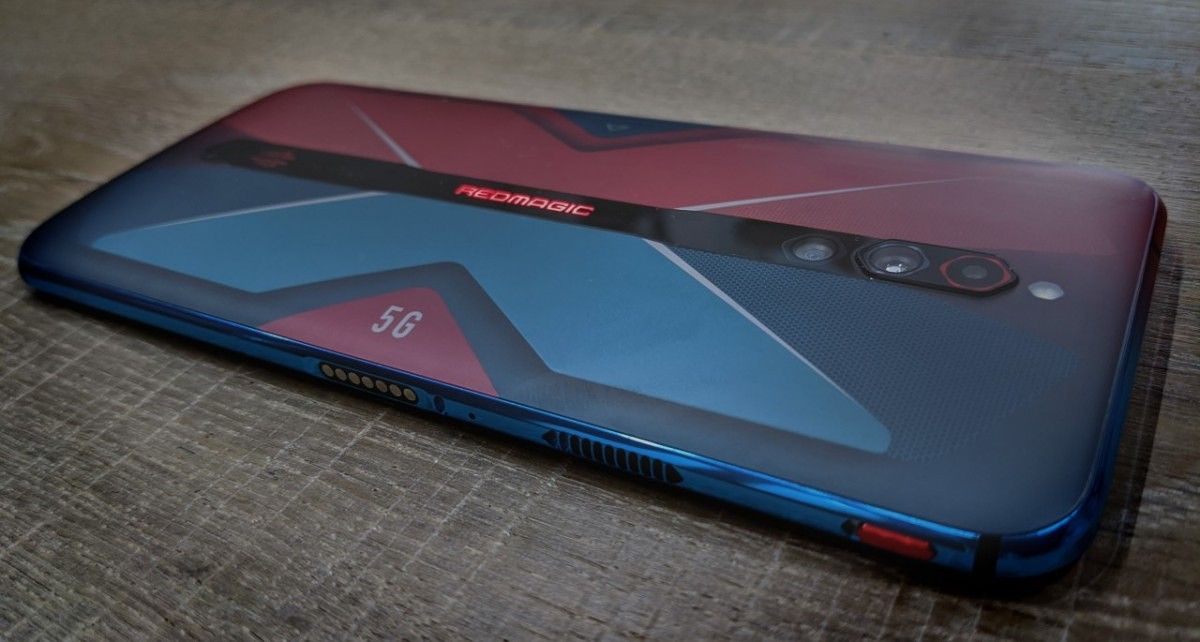
The design of the Red Magic 5G is very much that of a gaming phone. The back of the device features an aggressive “X” pattern with a red lit-up Red Magic logo across the middle. The frame is metallic blue and we can see one red button. We can also see the vents for active cooling and what appear to be connector pins for an accessory. GameBench says they were able to get over 5 hours of playtime on a charge while playing Real Racing 3 at 144fps. This is thanks to the big 5,000 mAh battery.

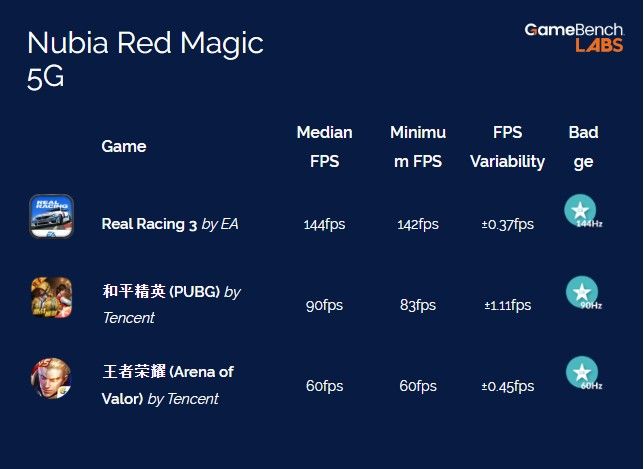
GameBench performed their testing with a pre-release version of the Red Magic 5G. This is the first handset they’ve benchmarked that delivers a stable frame rate of 144fps. They were able to record a median frame rate of 144fps with Real Racing 3, earning it their badge of Ultra-144. GameBench also tested PUBG Mobile and Arena of Valor (though they were the Chinese versions of both games).

PUBG Mobile and Arena of Valor don’t yet support 144fps, but they still performed very well on the Red Magic 5G. In PUBG Mobile, the team recorded a median frame rate of 90fps while in Arena of Valor, they recorded a median frame rate of 60fps. In the case of Arena of Valor, it was a perfect 60fps. Check out the chart below to see how all three games fared.

Source: GameBench

The post GameBench offers your first look at the Nubia Red Magic 5G and 144Hz gaming appeared first on xda-developers.


from xda-developers https://ift.tt/397LQ8i
via IFTTT

New Kr00K vulnerability affects many devices with Broadcom and Cypress Wi-Fi chips

ESET, an Internet security company that offers anti-virus products, just publicly disclosed a vulnerability in Wi-Fi chips made by Broadcom and Cypress. The vulnerability, which ESET calls “Kr00K,” allows for the unauthorized decryption of WPA2-encrypted network traffic. Devices with Broadcom and Cypress FullMac Wi-Fi chips, which, according to ESET, are found in the Amazon Echo/Kindle, Apple iPhone/iPad/MacBook, Google Nexus, Samsung Galaxy, Xiaomi Redmi, and more, could be vulnerable. Furthermore, even if a client device has been patched, an attacker can intercept network traffic if the wireless access point or router is unpatched.

Here is a list of client devices that ESET confirmed were vulnerable to Kr00k:

  • Amazon Echo 2nd gen
  • Amazon Kindle 8th gen
  • Apple iPad mini 2
  • Apple iPhone 6, 6S, 8, XR
  • Apple MacBook Air Retina 13-inch 2018
  • Google Nexus 5
  • Google Nexus 6
  • Google Nexus 6S
  • Raspberry Pi 3
  • Samsung Galaxy S4 GT-I9505
  • Samsung Galaxy S8
  • Xiaomi Redmi 3S

And here is a list of wireless routers that ESET confirmed were vulnerable:

  • Asus RT-N12
  • Huawei B612S-25d
  • Huawei EchoLife HG8245H
  • Huawei E5577Cs-321

ESET also tested Wi-Fi chips from Qualcomm, Realtek, Ralink, and MediaTek, but were unable to exploit this vulnerability. Since there are too many Wi-Fi chips to test on the market, ESET is working with the Wi-Fi Alliance to develop tools to detect vulnerable devices, and since January 16th, 2020, they’re also working with ICASI members to ensure that all possibly affected device manufacturers are aware of Kr00K. The vulnerability was assigned CVE-2019-15126 on August 17th, 2019.

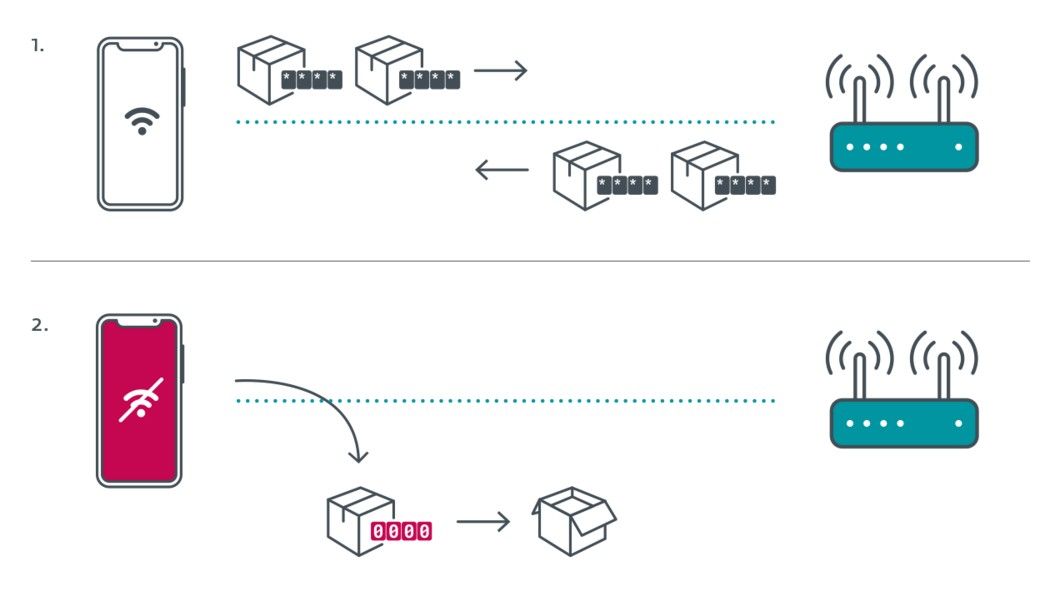
According to ESET, this vulnerability concerns encryption on the Wi-Fi layer and has nothing to do with Transport Layer Security, or TLS. An attack using Kr00k “degrades your security a step towards what you’d have on an open Wi-Fi network.” Specifically, the flaw causes vulnerable devices to use an all-zero Temporal Key (TK) to encrypt unicast data frames, which makes it easy for an attacker to decrypt some network packets transmitted by vulnerable devices. The bug occurs after a disassociation between a client device and an access point, which is when an access point re-establishes connection with a client device.

Here is a graphic published by ESET that demonstrates the difference between an unpatched client and a patched client communicating with a wireless access point.

Kr00K Attack Scheme. Source: ESET.

ESET only tested the WPA2-Personal and WPA2-Enterprise protocols with AES-CCMP encryption but did not test whether this vulnerability affects WPA3. Since ESET mentioned the vulnerability affecting Google Nexus devices, we reached out to Google regarding ESET’s findings and were given the following statement:

“Pixel devices are not impacted by this vulnerability. Affected Android device manufacturers were notified directly by Broadcom of the vulnerability and the patch.” – Google spokesperson

At this time, there’s no simple way to check whether your device or wireless access point is vulnerable to Kr00K. To find out if they are vulnerable or have already been fixed, you’ll need to reach out to manufacturers. ESET estimates that over a billion Wi-Fi-capable devices and access points could be vulnerable to this exploit, but that patches for devices by major manufacturers have already been released. According to ESET’s disclosure timeline, patches have been rolling out since Q4 of 2019. Custom ROM developers will need to wait for OEMs to release updated Wi-Fi binaries; unfortunately, older devices without active support from the OEM will be difficult or impossible to fix. For more information on Kr00K, visit ESET’s dedicated webpage.

The post New Kr00K vulnerability affects many devices with Broadcom and Cypress Wi-Fi chips appeared first on xda-developers.


from xda-developers https://ift.tt/32v4IvC
via IFTTT

[Update: Deprecating on April 21] Google Play will let developers earn more money by having users watch ads in exchange for rewards

Update (2/27/20 @ 2:40 PM ET): Google will deprecate the Play Console’s “Rewarded Product” monetization feature on April 21st.

The games category in the Google Play Store is by far the most popular app section on Android. This isn’t to say that there aren’t many decent regular apps to use; we highlight multiple new releases from our community members each week. However, mobile games just get more attention from developers because of how much money a good mobile game can make when it’s properly monetized. Some developers choose to sell their game at an up-front price while other developers have opted for the free-to-play model. No matter which method a developer goes with, Google has now introduced a way for them to make money while also rewarding the user.

If you’ve played any F2P mobile games in the last few years then you have likely been inundated by a massive amount of microtransactions. These games usually have two forms of in-game currency—one that you earn while playing the game and one that you earn slowly in-game, bought with real money, or both. However, there’s been a new trend that gives the user an in-game bonus while also letting the developer make some money from the most frugal of mobile gamers.

It happens in various ways depending on the game but you’ll often be offered the ability to watch a video advertisement to receive some sort of bonus. This bonus can come in the form of double the in-game currency for X number of minutes, an extra chance at a particular level, or anything else that can benefit the user. Developers could add this feature with Unity Ads, but now Google has announced they are building it into the Google Play Billing Library or AIDL interface with only a few additional API calls. The featured is called a “rewarded product” and instructions on how to set it up can be found here.

This means the developer doesn’t have to integrate any other SDK into their application or game which should reduce the work required to add this extra monetization opportunity. The feature is powered by Google’s Admob technology so developers will have access to the large number of advertisers who they are working with.

Source: Android Developers Blog


Update: Deprecating on April 21

Google’s “rewarded product” developer ad program is being cancelled before it leaves beta. The program was started a little over a year ago and allowed for things like watching ads to get in-game currency. Google built this feature into the Google Play Billing Library, but it will be depreciated on April 21st, 2020. Ad requests after that date won’t be fulfilled and there won’t be a way to view or manage rewarded products in the Play Console. Developers can provide a payout method for revenue from rewarded products before the cutoff date to receive their final payout. There will be a one-time exception for the minimum balance for payout.

Source: Google

The post [Update: Deprecating on April 21] Google Play will let developers earn more money by having users watch ads in exchange for rewards appeared first on xda-developers.


from xda-developers https://ift.tt/2HqPrnd
via IFTTT